
Managing Cache Coherency
Table of Contents
Write-back with Write Allocation (Default Configuration)
Write-through Write Allocation
Write-through with No-write Allocation
Changing Cache Policy During Code Development and Debug
Manage Stale Cache
If DMA changes main memory, there is no hardware mechanism to automatically update the associated cache. Your software will have to ensure the cache is coherent (not stale) when the core reads data from it. You can force the cache to reload specific lines (CACHE and PREF instructions) or force the core to read directly from main memory (KSEG1).
The following code example demonstrates how to read a variable defined in cached memory (KSEG0) from uncached memory (KSEG1). This uses the KVA0_TO_KVA1 macro (Kernel Virtual Address Segment 0 to Segment 1 XC32 C compiler macro) to translate a variable's cached address to its uncached address.
/* Declare a variable. By default it is defined in KSEG0 */int Var1InKseg0 = 5;/* Declare a pointer and use the KVA0_TO_KVA1 macro to assign it the uncached address of Var1InKesg0 */int *pVar1InKseg1 = KVA0_TO_KVA1(&Var1InKseg0);/* Assign y the uncached value of Var1InKseg0 */y = *pVar1InKseg1;
Manage Dirty Cache
Hardware will automatically update main memory if the core writes to cache. You can configure the hardware with one of the following options:
Write-back with Write Allocation (Default Configuration)
If the core writes to cache, the hardware will allow the cache to remain dirty until data is evicted from the cache. The hardware keeps track of the dirty cache lines and will write-back these lines to main memory when or if the data is evicted from the cache.
When the core reads from cached memory (KSEG0), it will first search cache, reading main memory only if the desired data does not reside in cache. The hardware automatically fills cache on a cache miss. This is called read allocation.
The core also has the ability to allocate cache lines for writes to cached memory even if the data isn't already in cache. This is called write allocation.
This policy is the easiest for the hardware to implement, and consumes the least system bus resources and power. It is also the least useful for keeping shared data coherent. Combining this cache policy with using uncached (KSEG1) memory for shared data is the simplest cache management approach, and is recommended for getting your project up and running.
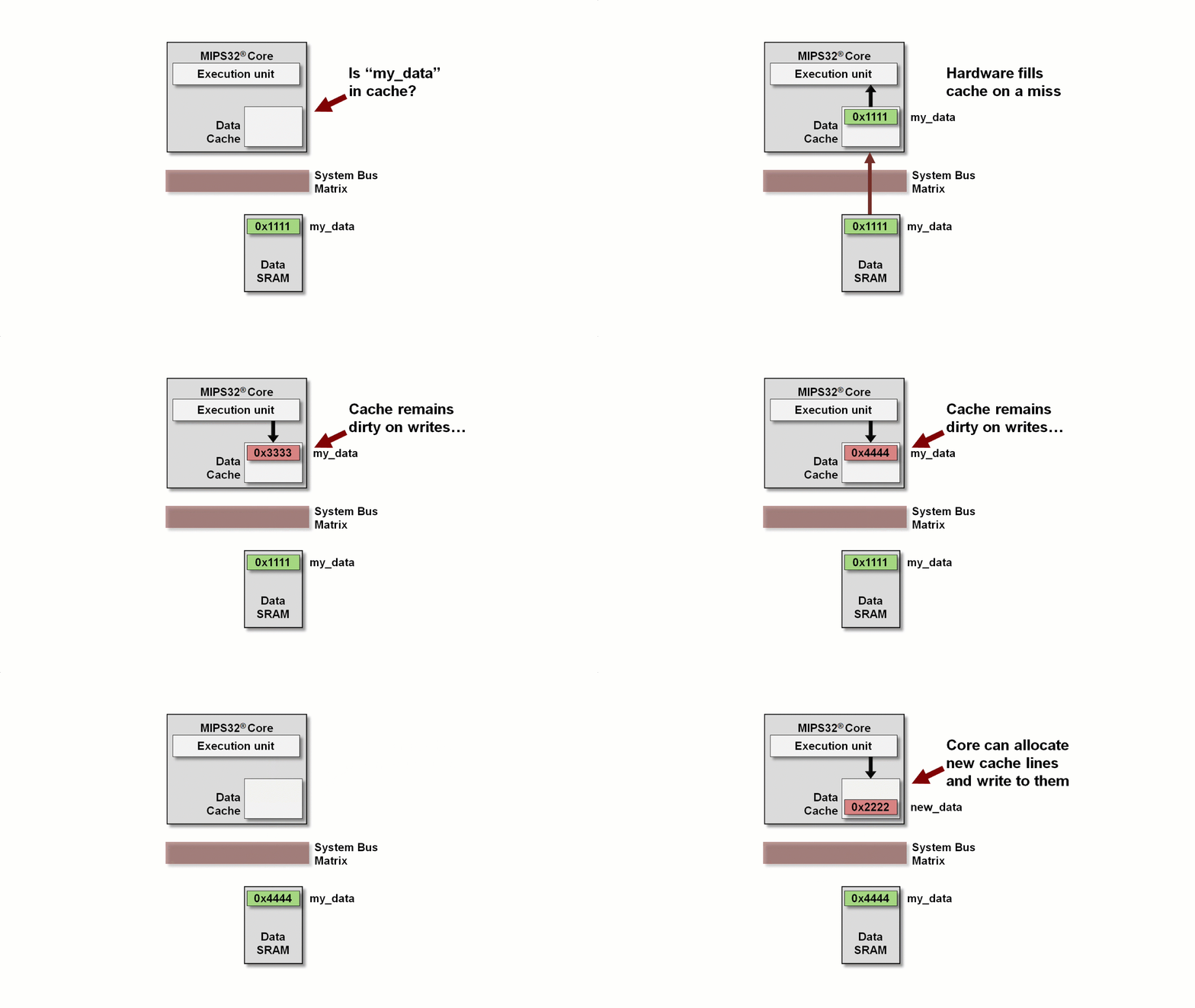
Write-through with Write Allocation
If the core writes to cache, the hardware will also automatically update main memory. This write-through configuration ensures data in the cache is never dirty.
When the core reads from cached memory (KSEG0), it will first search cache, reading main memory only if the desired data does not reside in cache. The hardware automatically fills cache on a cache miss.
The core also has the ability to allocate cache lines for writes to cached memory even if the data isn't already in cache (write allocation).
This policy ensures shared data is never dirty, but you will still need to ensure shared data is not stale.

Write-through with No-write Allocation
If the core writes to cache, the hardware will also automatically update main memory. This write-through configuration ensures data in the cache is never dirty.
When the core reads from cached memory (KSEG0), it will first search cache, reading main memory only if the desired data does not reside in cache. The hardware automatically fills cache on a cache miss.
The core does not have the ability to write to cache unless the data to be modified is already in cache. This is called no write allocation.
- If the core writes to cacheable memory, and the data is not in the cache, it will write to main memory only.
- If the core writes to cacheable memory, and the data is in the cache, it will write to cache and also update main memory.
This policy ensures shared data is never dirty, but you will still need to ensure shared data is not stale.

Cache Policy Recommendations
The recommended approach is to start with a writeback write-allocate (default) cache policy and use KSEG1 when accessing any memory used by a DMA peripheral. This is the simplest approach and in most cases, it will provide acceptable performance.
Once the project is running and debugged, performance can be improved by changing the access of DMA memory to KSEG0 and employing the CACHE and PREF instructions to manage coherency. In systems employing multiple DMA bus masters, software management of the cache can be used only where necessary and implemented on one DMA peripheral at a time simplifying the debug process.
Changing Cache Policy During Code Development and Debug
Microchip recommends the cache policy be configured by the run time start-up code, and should not be changed on the fly. For code development and debug, you may want to use the example code shown below to see how a given cache policy affects your code's performance. It should be placed at the top of the main() function.
Ensure that you exercise caution when changing the cache policy of KESG0 using the CP0 Configuration register. If disabling the cache, the existing entries are effectively invalidated and their contents are lost. If enabling the cache, it could contain stale or erroneous data and require initialization. Initialization of the cache and configuration for KSEG0 is assigned in the start-up code.
/* Cache Coherency Configuration Options (KSEG0) */#define UNCACHED 0x02 // uncached#define WB_WA 0x03 // write-back, write allocate#define WT_WA 0x01 // write-through, write allocate#define WT_NWA 0x00 // write-through, no write allocatevoid set_cache_policy(int cc){unsigned int cp0;cp0 = _mfc0(16, 0); // read the cp0 config registercp0 &= ~0x03; // clear the K0 fieldcp0 |= cc; // update K0 with the new value_mtc0(16, 0, cp0); // write the cp0 config register}int main(void){
set_cache_policy(UNCACHED); // set_cache_policy(UNCACHED);..... .....}
Note: The "K0" field in the code above refers to the cache coherency algorithm bits (K0<2:0>) found in the PIC32MZ’s CP0 CONFIG register. Please refer to the device data sheet for details.