Key Concepts
- The operational amplifier, often referred to as an 'Op-Amp,' is a very high gain, directly coupled voltage amplifier with two inputs (VIN+, VIN-) and a single output (VOUT).
- Widely used in electronic applications such as audio, medical devices, and automotive applications.
- Directly coupled (dc) voltage amplifier maintains its gain at low frequencies, down to dc.
- Ability to recognize the proper pin orientation of an integrated circuit.
- The differential amplifier as the first stage of an op-amp.
- The differential input mode of operation.
- The common-mode input of operation.
- The differential voltage gain (Av(d)).
- The common-mode gain (Acm).
- Op-amps amplify any signal that is applied to the inputs.
- Electrical noise can have a major impact on op-amp operation.
- The ability of an op-amp to reject common-mode noise signals (CMRR).
- The rate at which the output of an op-amp can change in response to a change at the input (slew rate).
Op-amps can be configured as amplifiers, comparators, integrators, differentiators, filters, oscillators, and special-purpose amplifiers. If configured as an amplifier, an op-amp can be connected in closed-loop and open-loop configurations using the concepts of both negative and positive feedback.
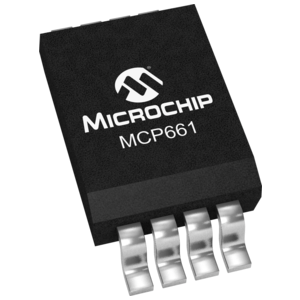
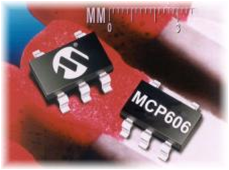
Microchip offers wide selections of op-amps - MCP661 60 MHz, 32 V/μs Rail-to-Rail Output (RRO) Op-Amp in SOIC-8.